Christopher's detective novel manuscript
The Curious Incident of the Dog in the Night-TimeChristopher's detective novel manuscript is at once the murder mystery Christopher sets out to write and a physical record of his investigation into Wellington's death. Its life in the story—from a school writing project to a book hidden in Father's room—makes it more than a container for clues: it carries Christopher's plans, exposes his inquiry to Father, and gives Christopher a reason to search a place where he discovers Mother's letters.
Purpose and Beginning
Christopher chooses a murder mystery because he likes puzzles and wants to write the kind of book he would enjoy reading. He finds conventional novels difficult to understand, whereas a good mystery offers a defined problem: work out who committed the murder, then catch that person. The genre gives him a structure based on evidence and a solution that a reader might reach before the end.
The book begins with a dog because Siobhan advised Christopher to open with something attention-grabbing. Christopher also chooses the dog because the event happened to him; imagining events that did not happen to him is difficult. The opening therefore makes a writing choice and establishes the manuscript's method: its narrative grows from Christopher's own experience rather than from invented scenes.
A Record of the Investigation
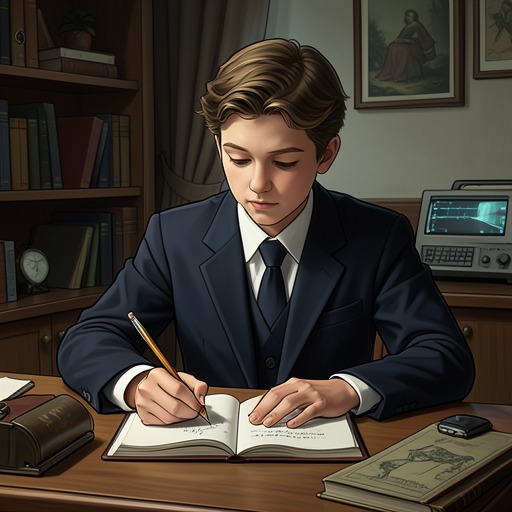
On a Good Day, Christopher decides to find out who killed Wellington, since he regards such a day as suitable for projects and planning. Siobhan suggests that he write about finding Wellington and going to the police station, and Christopher says that this is when he starts the book. She offers help with spelling, grammar, and footnotes. The manuscript thus develops directly from the investigation, with a teacher's practical support, rather than being a separate fictional puzzle.
As Christopher follows clues, the book gathers the reasoning through which he tries to identify a suspect. Looking through the window of Mrs. Shears's locked shed, he sees a cleaned fork beside other garden tools with matching green plastic handles. He considers whether the fork could be a misleading clue, then reasons that whoever used it may have had access to the shed or the garden. Later, he lays out a chain of explanations for why someone might kill a dog and identifies Mr. Shears as his prime suspect because he knows Wellington and Christopher thinks he might want to make Mrs. Shears unhappy. The written investigation preserves both observations and provisional conclusions; it is evidence of Christopher's thinking, not proof that his suspect is guilty.
Christopher takes the manuscript to Father by telling him that it is a book he is writing. When Father asks whether the account is true and whether Christopher spoke to Mrs. Alexander, Christopher confirms that he did. At this point the book's record of the investigation has become a source of conflict at home: it contains information Father does not want Christopher pursuing.
Interruption, Loss, and Recovery
Father discovers the book after Christopher has left it on the kitchen table while watching a Blue Planet video. Christopher describes this lapse as relaxing his guard, something a detective should never do. The manuscript's exposure follows from an ordinary distraction, but it changes the stakes of keeping his inquiry private. During the confrontation that follows, Christopher and Father fight. When Christopher regains his bearings, the book is bent in half and damaged; Father later takes it outside and puts something in the dustbin. Christopher does not see what happens to the manuscript then.
The next school day, Siobhan asks about Christopher's facial bruise and he recounts the fight, but the account also establishes that the book remains important to him. When he gets home and finds Father away, Christopher uses the key from the small china jug in the kitchen to open the back door and check the dustbin. He wants the manuscript back because he likes writing it, values the difficult project, and has kept his discovered clues in it. The book's disappearance threatens both the work itself and the investigation that it contains.
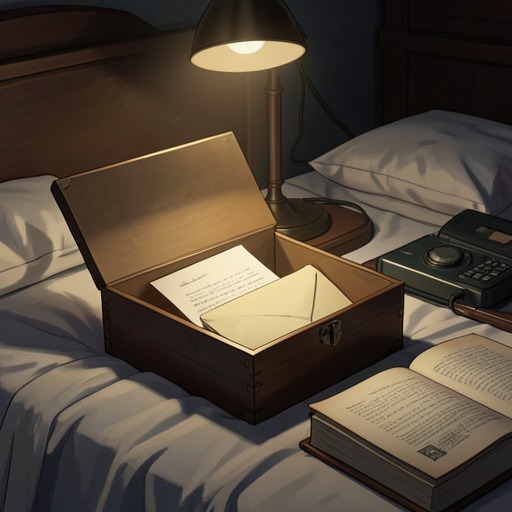
The manuscript is not in the bin. Christopher finds it instead in an old shirt box beneath a plastic toolbox in Father's clothes cupboard. He is relieved that Father did not throw it away, but taking it would mean going against his promise not to interfere with Father's things, and he expects Father to be angry if he discovers the search. The book is therefore recovered at a cost: preserving his own project requires Christopher to enter a space governed by a promise he has made.
The Unfinished Ending and Wider Significance
For a time, Christopher believes the book is finished because Father has forbidden him to continue detecting. At school, Christopher shows Siobhan the pages he has written, including a diagram of the universe, a street map, and prime numbers. Siobhan tells him the work is good and that he can be proud of having written a book, even if it is short. Christopher objects that it has no proper ending: he has not found Wellington's killer, so the murderer remains at large. Siobhan answers that life does not guarantee solved murders or captured murderers. The manuscript's incompletion is not a puzzle solved on schedule but an honest limit on what Christopher knows at that point.
Its clues and conclusions also gain a different meaning as the story develops. Christopher's early suspicion of Mr. Shears remains a theory grounded in his chain of reasoning, not the final answer: Father later confesses that he killed Wellington. That reversal makes the manuscript's detective form central to the book's treatment of evidence and trust. Christopher has recorded what he can observe and infer, while the person nearest to him has concealed the decisive fact. The manuscript is consequently both a personal project and a material trace of Christopher's search for a truth that destabilizes his family.
The shirt box deepens that role. Beneath the manuscript, Christopher finds an envelope addressed to him, and its postmark establishes that Mother wrote to him eighteen months after she was supposed to have died. The manuscript has led him into the place where the concealed letters are kept. What began as a book about identifying a murderer thus becomes entangled with a second revelation about family secrets: the physical record of Christopher's investigation sits beside evidence that Father's account of the family is false.